Modeling an Inventory Tracking System
A deep dive into modeling an inventory system used in the beverage manufacturing process
Introduction
I wanted to create a side project to keep my tech skills sharpened, and also to provide an example of my work (employers tend to want to see this kind of thing). I decided to skip all the usual ecommerce, twitter clone, social media type examples and work with a more real world example. After some carefull thought, I decided to revist an actual past project I had worked on in the past where our team was responsible for implementing an ERP type system, specifically one responsible for entry of work orders, and updating inventory related information.
So basically this project models the internals of tracking activity during a beverage manufacturing process. We need to support the ability to select a given piece of equipment, and gain visibility into all related recent activity. Additionally, in the event of a product recall, we need to support the requirement to trace all impacted products from a root cause for the recall. This is a good illustration of implementing logic beyond supporting simple CRUD operations, and the unit level testing efforts surrounding it.
This past project particularly sparked my interest as there was a lot of technical debt associated with the project, inclusive or some bad design decisions, performance issues, and an outdated tech stack. In all fairness, a lot of effort went into the design, however at the time of the implementation (around the early 2000s) a lot of the technical options we take ever so for granted these days either did not exist or were in their infancy. These include widespread adoption of messaging queues, and the browser's inherit ability to make asnyc calls to API endpoints. Yes, that right, there was a time when Ajax type calls did not exist! The application was a monolith, packed full of complex business logic, and was anything but performant. Although the application was a true nightmare, the lessons learned I would describe as nothing short of an invaluable learning experience, worth it's weight in gold. It turns out, the system was the largest globally for that market space, driving mission critical operations for a fortune 500 company, with all the complexities to match. Let's briefly dive into a few of the pain points.
Large monolithic application
The application consisted of just under 200 screens, supported by around 300 tables in an RDBMS. Deployment was 'big bang', where the entire application was packaged and shipped during a promotion cycle.
Overall poor performance
Performance was an issue, and could be described as 'slow' and 'slower'. This was a result of inneficient use of an ORM layer, inclusive of the mapping of persistent objects into value object equivilents. ORMs are fairly easy to implement, however without carefull thought, they can lead to inneficient interactions with data. In one common use case for example, it was common to observe 3,500+ queries issued to display around 150 records.
Tightly coupled design
As I had previously mentioned, this was a limitation of the tech available around the early 2000 period. State was managed on the server, not in the browser. An insane amount of work was required to track uncomitted chages as the user navigated through the application.
Fast forward to an modern day architecture. This effort on my part is a chance to revisit what I affectionately refer to as 'the beast'. With modern tech options, and no upper level management to act as a bottlneck for decisions, I was pretty exited to take on a rewrite. Given that fact that this is a side effort, I will only be attempting to implement a subset of the functionality, however enough to illustrate the concept and demonstrate specific optimizations. Additionally, I will change the actual industry in which the system is designed for in order to preserve any potential IP on behalf of my former employer.
Too keep things interesting, I decided to provide implementations in two different tech stacks, and I reserve the right possibly at some future point to perhaps add an Python implementation as well. I am very comfortable in Java/Spring and NodeJS/Express/TypeORM, so I decided to provide implementations in those two stacks. In order to make the most effective use of my time, I made use of a code generation framework I use to reduce boilerplate code. While AI/Vibe coding, etc. appears to be all the hype these days, I have been working with code generation technologies for over a decade, and the current AI solutions just quite are not there yet.
Source for the project is available under my GitHub account at the following locationhttps://github.com/west-coast-matthew/blog-tank-tracing
An overview of the domain problem
This application is targeted for the beverage manufacturing space. Raw materials are basically purchased, for which a series of operations are performed, until finished consumer good are produced. For illustration purposes, we will design the system for an imaginary organization that produces various fruit juices. In addition to recording operations, tracking work status, and calculating inventory levels we need to support very strict legal compliance work flows. This includes maintaining the ability to historically track product origins, which components were used during the manufacturing process, which lots they are associated with. This is critical for scenarios where a product recall comes into play, this requires very accurate recording of all activity, as peoples health may be at risk. This may not seem very sexy, however this involves the use of data structures, and within hte scope of my efforts some performance optimizations to meet the needs of of a somewhat unique use case.
I will go into a bit more details about the domain problem for the purposes of providing just enough background to understand my design decisions, but feel free to skip ahead to the following sections that address the more implementation specific details.
Work orders
This should be a familliar in the manufacturing space, this should be a familliar concept, however I will touch on this a bit. Basically a work order is just a record of an operation, or some type of work to be performed.
Work orders assume the following states:
draft->ready->in progress->completed->validated / cancelled
The general series of steps should be relatively self explanitory, with the golden path resulting in a final state (validated) where the record is essientially frozen or archived. It's worth understanding the difference between the two main final steps in the work flow, completed and validated. As the name implies, completed work orders are essentially done, however they are not moved into the final validated state until a dedicated compliance role reviews, and potentially makes adjustments before the final sign off.
The general manufacturing process
I have no specific experience with the manufacturing process for fruit juice, however I will attempt to apply what I have learned from the wine industry to conceptualize the workflow. Primarily raw goods are aquired by the manufacturer. An example of this would be oranges, apples, grapes, etc. These materials are washed, and juice is extracted. Initial pasturization and filtering is performed, and then a series of additional steps are performed before the product reaches it's final state. It is important to note that raw materials are aquired in large batches, and then stored in large long term containers. The actual pace of producing the end product is performed in an just in time manner in order to minimize the wherehouse space required to store finished goods. This is an efficient model as products are manufactured against projected demand models. Storing unfinished goods in bulk is cheaper and easier to control then letting finished goods sit in a wherehouse.
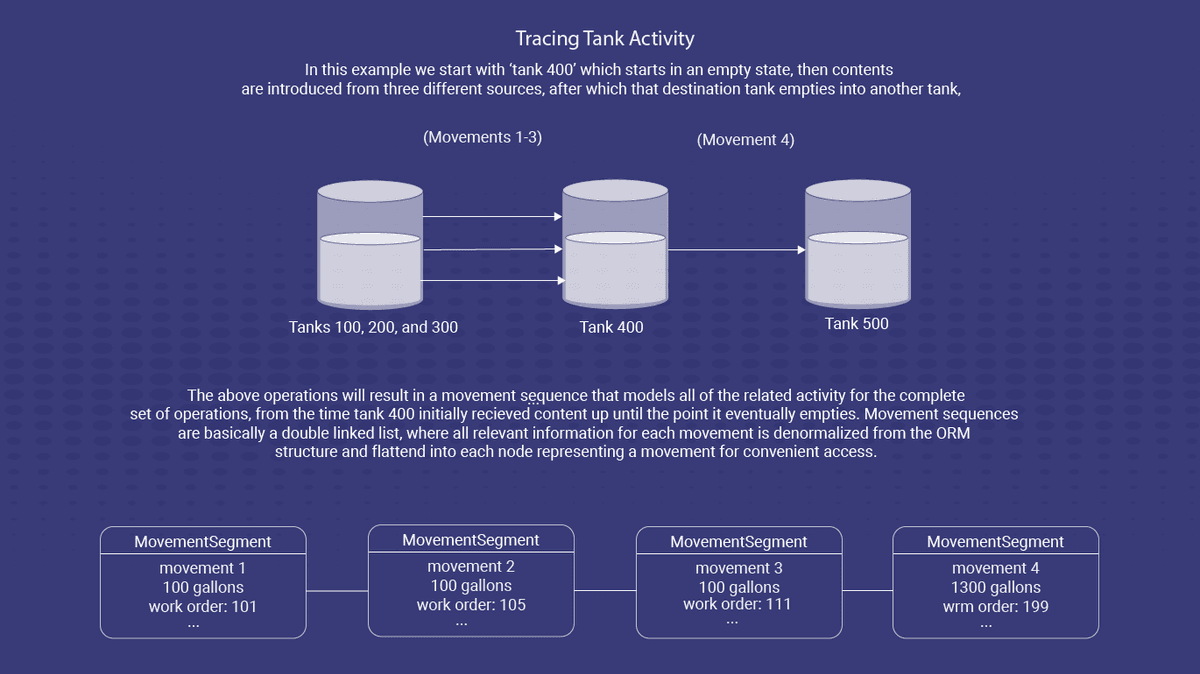
During the overall manufacturing process, content is moved between a series of tanks, as various operations are performed, until they reach the final consumer packaged state. The transition of content between tanks is referred to as movements, essentially a step in the overall process, each driven by a unique work order. It is important to understand this process as we can assume that there is a minimum of a dozen or so steps or movemements beteen initial aquisition of fruit until a final product is produced. We are moving at scale, where hundreds of operations are performed on a daily basis, and many operations are closely related. Each tank starts at an initial empty state, and will return to an empty state at some future point, however the point at time in which a
- Oranges are delivered by several truck loads where they sit in a large bin
- The oranges are washed, and then they juice is extracted via a crushing process, the resulting juice is stored temporarily in a large bulk storage tank
- The juice is then pasturized in smaller batches as the equipment responsible for this has a smaller capacity that the original bulk storage tank. At some point, once this step is completed, then pasturized juice ends up in yet another bulk storage tank temporarily
- From this point, the juice is divided with the intent of ultimately ending up in one of three final consumer products: with pulp, low pulp, and no pulp with calcium additive. the contents of the bulk storage tank at this stage marks the beggining of separate paths through the physicial set of subsequent tanks through the manufacturing process. Think of this as a fork in the road, where the original oranges from a common orchard begin individual journeys to their final state. It's entirely possible the juice intened for the pulp product makes it from the orchard to a retail shelf in a manner of a few weeks, while the other variants may take in upwards of 6 months to reach that final state.
The take away here is that as different end consumer products go through different steps, although they originate from a common origin, the further down the manufacturing process, the more variables come into play. Should there be a salmonilla outbreak from the originating orchard (purchase lot), we need to establish associations for essentially every branch of anything that happened down the line needs to be identified in order to effectively perform a product recall. The entire set of activity from the first until the last transaction falls into scope. In another example, perhaps at some point mid level in the manufacturing process, a recall is performed against an ingredient addition that was only performed on one of the branches of the manufacturing process. In that second example, only a subset of related activity would fall under scope of a recall in that instance. This point should illustrate the importance of establishing the series of operations, and requirement to retroactively identify the origins of product at some given point in time.
The Resulting Object Model
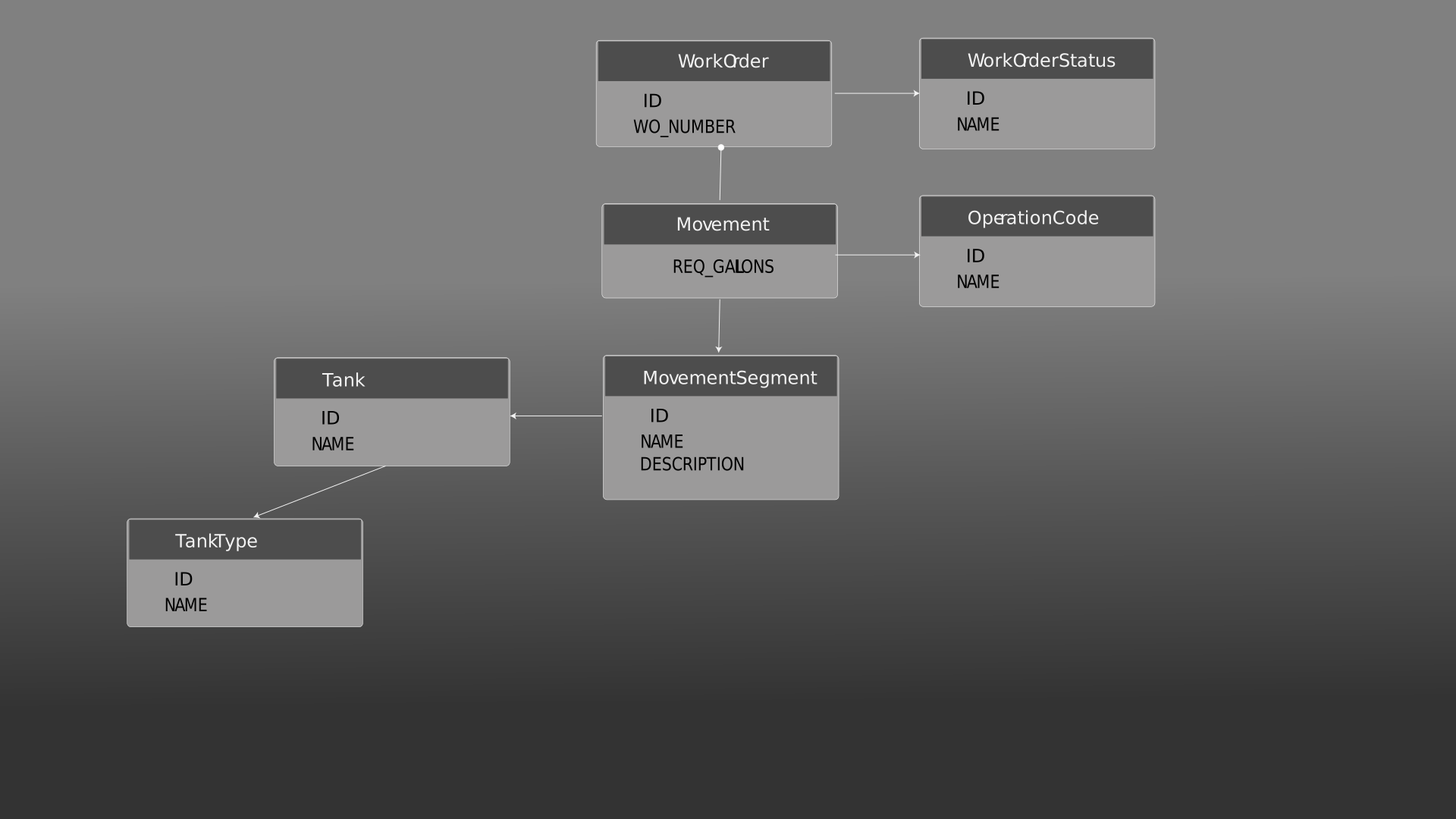
Let's take a look at the object model, which is as follows.
Tracing Activity
So given the above problem at hand, we need to track what is happening not only for any given selected activity, but other related operations. Additionally, we need to support the ability to trace historical activity in the case that there is a product recall.
From an object modeling perspective, the work order is considered the cornerstone of the system, for which, everything is driven from. That said, just take a look at the relational model.
Work orders consist of one or more movements. Quite often this means that a request for the contnents of one tank to be moved into a series of destination tanks, or the inverse where the contents of multiple tanks are joined into a final destination. Each individual movement consists of a source and destination, usually two different physical locations, but sometimes recorded as the same. Take into consideration a case of where something is pasturized. This step in the process involves a single piece of equipment, a tank where the contents are heated to a set temperature, maintained for a period of several hours, and then transferre dto a refridgerated unit.
The concept of a movement consists of two movement segments. This is true for general use cases where content is transferred between two physical locations, and also for cases where a there is no physical movement. It's worth noting that at a movement level, there is a requested number of gallons to be moved, however in real life there are potential slight losses as a result of the pumpin gprocess. Additionally, when dealing with temperature changes, liquids expand and contract, so two additional fields have been added to the movement segment entity 'adj_prev_gallons' and 'adj_after_gallons' to allow an operator to override physical measurements. This background is provided only to introduce a level of complexity into the project that creates a requirement for additional business logic, establishing enough meat on the bones to inroduce dedicated logic and creating the requirement for unit testing to validate execution against those cases.
hopefull hit the right level of background to introduce some domain specific requirements, enough to make the project interesting, I am not shooting for an simple CRUD based project here.
Once an work order is completed, validated, reaching it's final assumed state, the resulting state of the tank/piece of equipment needs to be calculated. At a high level perspective, a weighted average. For example, a work order is initiated to move 400 gallons from one source, and 600 gallons from another source into a common destination....
The devil is in the details here as if an adjustment is made retroactively spanning back let's say 6 months, then this can impact thousands of transactions, we need to roll back the clock, not only recaulculate that operation from that given point in time, but from a time perspective moving forward update every impacted transaction. Lot's of recalculations, a fair amount of processing power, and an default dependance on an general ORM approach creates a performance issue, I will touch on that a bit later in my decision making process.
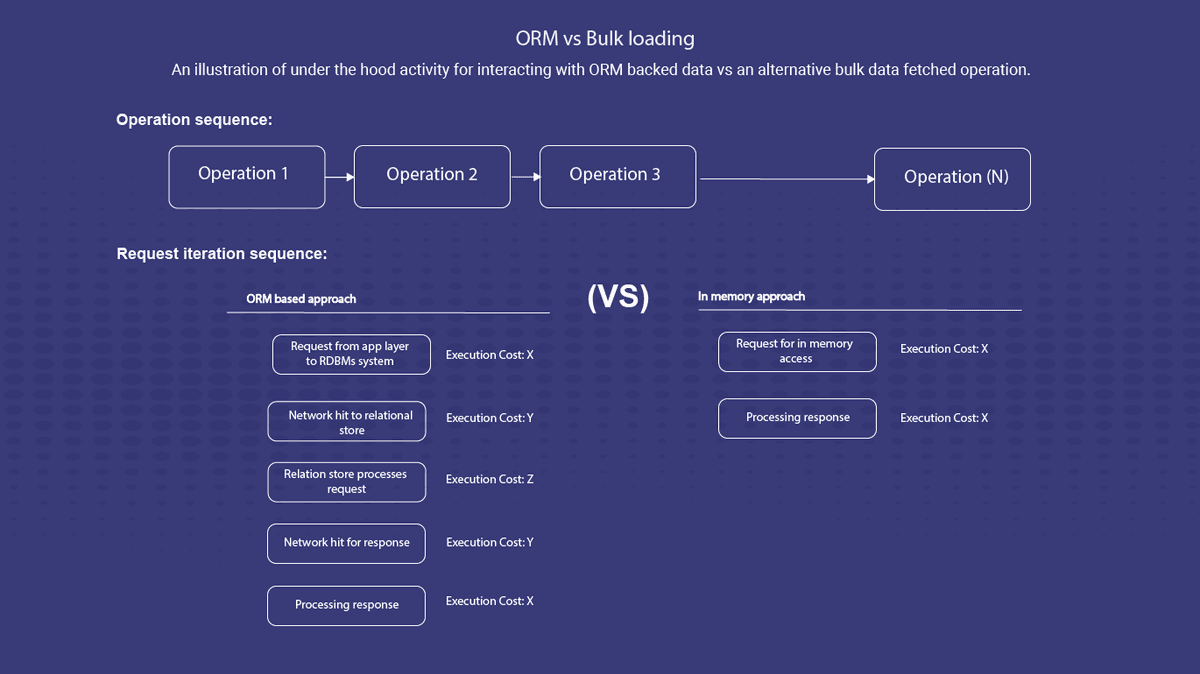
So given the above diagram, the 'operation sequence' illustrates a series of operations, it is implied as an potentially infiniate amount, but let's call 5,000 an example of the number of times data is fetched during the process osf servicing a given request.
The 'Request iteration sequence' section details what happens at each step in the overall process. It is hard to assign exact times for each individual step, there are a lot of potential variables that come into play, but I will attempt to generalize efforts as follows:
- X represents processing time, generally consistent.
- Y represents the network hit. This can be a variable, however based on my past observations, this can take 2-5 MS as a safe assumption. A small, almost insificant amount of time, however the key point here is that each operation adds up in the larger scope of things.
- Z represents the variable time for the relational store to handle the external process request. So worst case scenario, file IO operation, however a lot of relational database will self tune or support the ability to definitively tune request operations.
At first glance we notice the contrast between both approaches, we skip the round trip network hits, and the internal processing of the request to access data. With an in memory based approach, we essentially eliminate a few steps required to stage the data for the parent operation. Performance is good, really good.
Imagine a use case where the data required for a decision point traverses a graph of objects, resulting in a series of queries as a result of the lazy instantiation based approach towards accessing the data. In this case, around 10 calls to the database to retrieve the entire object needed to apply logic towards. So if the network hit to retrieve the data and then map it into a an object wrapper takes around 5ms, and on average 10 calls are made, we are looking at around 50ms per individual operation, and when processing 1,000 operations withing a larger transaction, then that adds up to around 50,000 ms, or five seconds. This is represented by the Y and Z time allocations in the 'ORM based approach' represented in the diagram. In contrast, the 'in memory' approach skips the Y and Z steps.
This might seem to be a trivial amount of time, however the actual project that this effort is based was exponentially more complex, and handling requests such as processing six months worth of data would result in transactions running in upwards of 45 minutes, which was a significant performance hit, enough to merit an alternate in memory based approach.
The act of loading data into memory comes at a cost of complexity, introducing additional requirements such as synchronization, and potential memory limits, however if we are shooting for high performance, and the size of the data set is within reason, then this approach towards loading and storing the data makes a lot of sense.
Optimizing for performance
ORM techology is great, however it can lead to performance issues if not used carefully. In this case, we are dealing with a large number of transactions, so from first hand experience, I can attest to the fact that performance can be a real issue. The ability to lazy load data from a programming perspective, and although a single database call may take a few milliseconds, when you multiply that by thousands of transactions, the performance impact can be significant.
In order to avoid the performance issues in the past, I decided to take an approach where data is bulk loaded into memory, from which point all operations are perfomed on the in memory model. We can make assumptions about the size of the data, and it is reasonable to assume that we can comfortably fit the entire data set in memory.
During the initial load process, we can safely some of the data through operations such as Model.findAll(), this works well for entities which have no relations, however for entities which do have relations are loaded directly via SQL, and then manually marshelled into model instances. This does require quite a bit of heavy lifting, but offers an optimized way to load the data.
Project structure
The supporting project for this article is Node.js based, however the concepts apply to other stacks. At a future point, I will attempt to provide a java implementation for further illustrate the fact that the concepts are universal.
There was a fair amount of heavy lifting that went into loading and staging the in memory data structure, so a dedicated file was established for this purpose (./src/services/entity-load.service.ts). In addition to loading the data, we need to map the data into it's final format, so an additional file (./src/services/entity-mapping-service.ts) was created to suit that purpose. Finally, a third file was created in order to actually handle the requests for tracing operations (./src/services/inv-tracking.service.ts).
With each of these files reaching a few hundred lines, it made sense to divide them into purpose specific units.
Unit testing
Implementing what could be condsidered 'complex' business logic is hard to get right, and hard to provide that it works. This is a gold case for unit level testing, which involves staging the data for the operations. The decision was made to use a mock based approach towards staging the data. This provides greater control over the staging the required data for various use cases.
The level of effort to stage data and perform testing was fairly sustantial. So we have around just under 1k lines of code to test and around the same lines of code allocated towards staging mock data and testing.
I have covered enough ground in this article so I won't go into further detail a per the testing aspects as I cover this in another article.
Tracing movements
So one of the top level use cases is to accept an reference to something that had ocurred at specific point in time and then identify all associated activity with the targeted piece of equipment.
The file responsible for handling tracing activity (inv-tracking-service.ts) exposes the high level method 'getMovementSequenec' which is used to retrieve associated activity for a selected piece of equipment and point in time. Based on the arguments, we navigate to the first event for the targeted piece of equipment, and then proceed forward historically until the final or last recorded event. For example, If contents from three individual tanks were pumped into an empty tank, and any one of the movements were passed into the trace method, the method would return all of the movments as they represent a series of related events.
The data structure that represents each movement is referred to as an MovementSummary, which essentially is an object that contains a denormalized collection of data for an activity for ease of consumption. The MovementSummary functions as a node in a Linked List, where each MovementSummary instance contains pointers to the previous and next elements in the sequence of events.
Identifying the first or original movement in a sequence1export const traceBackwards = (
2 tankId: number,
3 mvmntRef?: Movement | undefined
4): Movement => {
5 if (!mvmntRef || mvmntRef == undefined) {
6 throw Error(`Method must accept a value for the 'movement' argument`);
7 }
8
9 // So if the referenced movement did not actually involve a physical
10 // transfer (which would be the case in a cooling operation), then
11 // we look at the 'source' side of the movement.
12 if (!mvmntRef.isActualMovement()) {
13 // If there is nothing more to trace, then the referenced movement
14 // is the last in the chain.
15 if (!mvmntRef.source?.prevMvmnt) {
16 return mvmntRef;
17 }
18
19 return traceBackwards(tankId, mvmntRef.source?.prevMvmnt?.movement);
20 }
21
22 // If the current movement reference represents a movement into
23 // the referenced tank, and that tank was empty prior to the operation,
24 // than we have identified the initial movement.
25 if (!mvmntRef.dest) {
26 throw Error(
27 `Referenced movement has no destination information associated with it.`
28 );
29 }
30
31 if (!mvmntRef.dest.tank) {
32 throw Error(
33 `Referenced movement has no destination tank information assigned.`
34 );
35 }
36
37 if (mvmntRef.dest.tank.id == tankId && mvmntRef.dest.previousGallons < 1) {
38 return mvmntRef;
39 }
40
41 // At this point, the current movement reference does not refer to the original
42 // movement, so we need to recurse to identify that original movement.
43 // Basically we recurse until the 'initial' movement is found.
44 return traceBackwards(tankId, mvmntRef.source?.movement);
45};The above example is the code responsible for accepting an movement within a series of related movements, and then identifying the first moement in the series. This would be the point in time where the tank was originally empty. This is the initial step in the process of identifying a sequence of movements. As the object structure contains FK relations to other movements, the traceBackwards method utilizes recursion to perform the tracing operation.
The next steps in the process involve repeating the process in a similar manner where a recursive trace is perform from the initial point in the sequence of movements until the final or last recorded movement is encountered.
The intent of tracing is to provide an summary of all the related operations. The data of interest lives across 7 objects, and from the consumer's perspective is not necessarily important, so we take the resulting movements that are identified and convert them into a flattened value object for simplified consumption.
The Movement value object1export interface MovementSumary {
2 workOrderId: number;
3 workOrderNumbr: string;
4 completionDate: Date;
5 validationDate?: Date;
6 movementId: number;
7 sourceTankId: number;
8 sourceTankName: string;
9 destTankName: string;
10 destTankId: number;
11 origRequestGallons: number;
12 sourceBeforeGallons: number;
13 sourceAfterGallons: number;
14 destBeforeGallons: number;
15 destAfterGallons: number;
16 prevActivity: MovementSumary;
17 nextActivity: MovementSumary;
18}
19Conclusion
I hope that this article sparks some interest and provides an insight into how I have attempted to tackle the problem of modeling an inventory tracking system. The GitHub project is fully functional, inclusive of a comprehensive set of unit tests.
All too often I see developers publishing projects that are basically CRUD based applications with a few extra bells and whistles, so I wanted to showcase a real world project, that otherwise would not be possible as most of the code I have produced during my career is proprietary in nature, and is typically IP that belongs to an employer.
Source for this project can be located on GitHubhttps://github.com/west-coast-matthew/blog-tank-tracing